
The Resurrection Of One Of London’s Great Houses
After two decades behind closed doors, Cambridge House is preparing to reopen as one of London’s most ambitious luxury destinations. Studio PDP is leading the adaptive reuse of the Grade I-listed mansion, balancing heritage with modern hospitality.
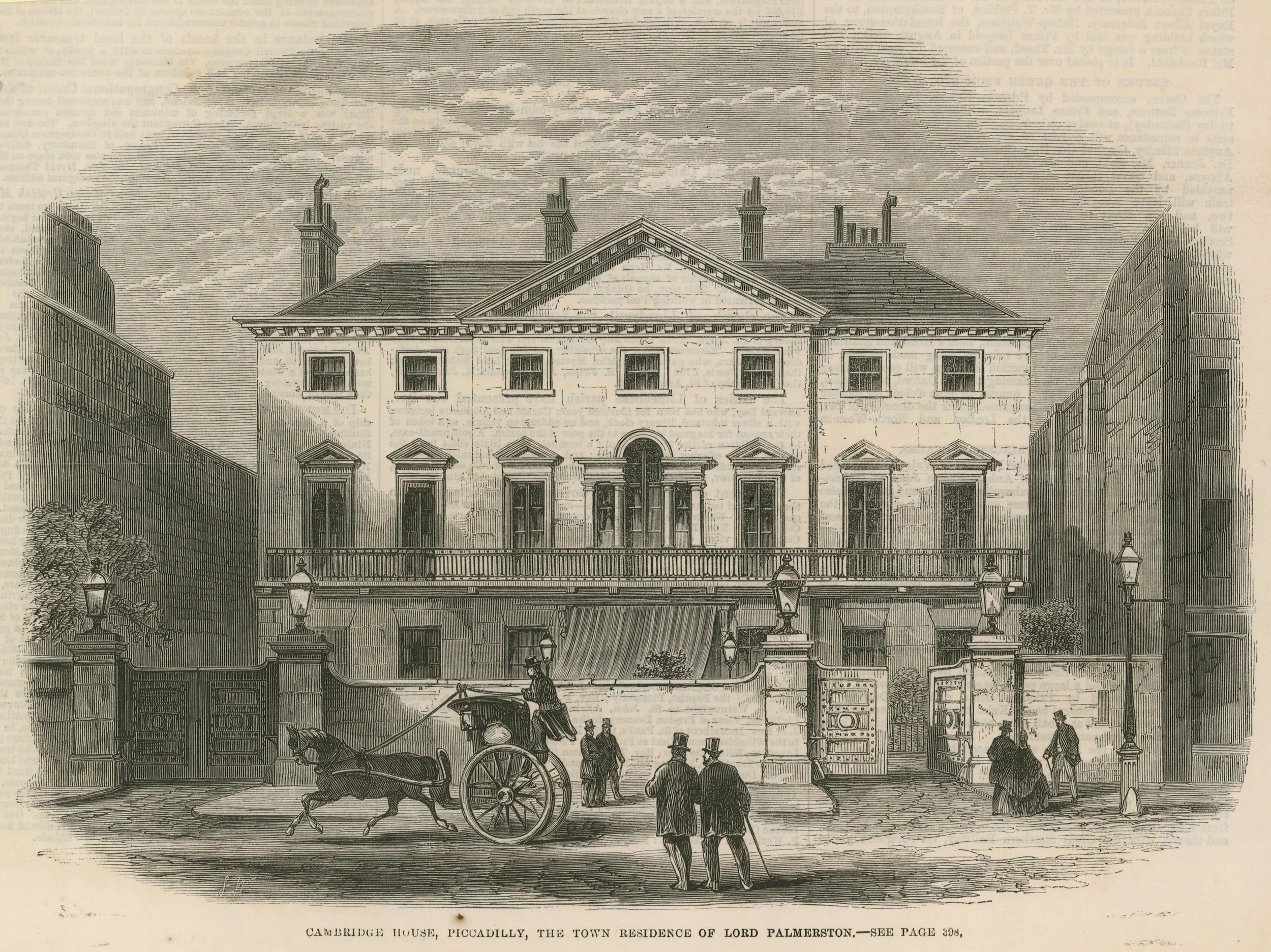
Lord Palmeston’s House 1850s? (Westminster Local Archive)
Royalty lived here. A prime minister entertained London's political elite here. Queen Victoria walked through its gates. For more than a century, admirals and generals called it their club.
Then, for more than two decades, Cambridge House fell silent. Now one of London's great houses is coming back to life.
Built in 1756 for the Earl of Egremont, 94 Piccadilly later became home to Prince Adolphus, Duke of Cambridge, before passing to Lord Palmerston. While prime minister, Palmerston used Cambridge House as an unofficial extension of Downing Street, and his gatherings made it a centre of Victorian political and social life. When he died in 1865, his funeral procession left from here for Westminster Abbey.
Later came the Naval & Military Club. Its famous carriage gates, marked simply IN and OUT, gave the club the nickname that became synonymous with Cambridge House for more than a century. But when the In & Out departed in 1999, the doors closed. Years of vacancy, water ingress and decay followed.
In early 2027, they open again.
For client Motcomb Estates, Studio PDP is the architect and lead designer for the adaptive reuse of Cambridge House, transforming the Grade I-listed mansion and its surrounding buildings into a 102-room luxury hotel, seven private residences and a collection of restaurants, bars, members' spaces and wellbeing facilities.
And the significance extends beyond Mayfair. Cambridge House will mark Auberge Collection's first hotel in the UK, bringing the US-based luxury operator to London's via one of the Capital's most extraordinary historic addresses.
But this is far more than a restoration. The challenge has been to retain the character, craftsmanship and extraordinary history of Cambridge House while completely rethinking how it can work for another generation.
Behind the familiar Piccadilly façade, the scale of that intervention is astonishing. The development extends four storeys beneath Mayfair, inserting the infrastructure of a modern hotel below and around some of London's most sensitive historic fabric. At 90-93 Piccadilly, a Grade II-listed façade and staircase were retained while structures around them were dismantled, at one stage leaving the staircase seemingly suspended in mid-air.
Even the movement of the city below had to be designed around. With the Piccadilly line running metres away, conventional acoustic treatment would have compromised the historic rooms. Instead, the existing structures were separated at lower-ground level and placed onto specialist acoustic bearings, isolating the buildings themselves from Underground vibration.
Above ground, the work becomes considerably more delicate. Historic façades are being meticulously repaired, while inside, decorative plasterwork, joinery, stonework and other surviving details are being conserved and restored by specialist craftspeople. The principal rooms retain their remarkable scale and sequence, while new interventions are carefully woven through the historic fabric to allow a building conceived in the 18th century to perform as a 21st-century hotel.
Interior designer Jean-Louis Deniot is shaping the hotel and guest spaces, while Laura Gonzalez is bringing her distinctive approach to the bar, wellbeing spaces and members' club. The ambition is that the extraordinary amount of work behind the scenes feels almost effortless when the building opens.
And perhaps that's Cambridge House's greatest trick. Beneath the restored rooms will sit years of excavation, structural ingenuity, conservation and craftsmanship, yet the finished building should still feel unmistakably like Cambridge House.
London is spending billions creating its next generation of luxury destinations. But history, character and a genuine sense of place can't simply be specified into a new building.
You can build another five-star hotel. You can't build another Cambridge House.
Studio PDP will be hosting a limited series of behind-the-scenes tours in the New Year, offering a rare opportunity to see Cambridge House as it approaches completion.

Studio PDP Partner Andrew Davidson, who leads the project, will also be discussing the challenges and opportunities behind Cambridge House at Bisnow's Building for the Future: The UK ESG Real Estate Conference.